
Yes, if you want Kyoto's temples without the crowds and can swap the snow fantasy for cold, clear days. Kyoto's major hotels averaged ¥17,678 a room in February 2026 against ¥31,296 in April, about 44% less, at 73.7% occupancy instead of 85.1%. Snow is the catch: Kyoto averages about four days a winter with at least 1 cm on the ground. Here are the odds, the prices and the dates for December 2026 to February 2027.
Is Kyoto worth visiting in winter?
Yes, for a first-timer who cares more about the temples than the weather. January and February are Kyoto's cheapest months, at ¥17,645 and ¥17,678 a room on average in 2026, and its emptiest: hotel occupancy fell to 65.7% in January. Days reach 9-10°C (48-50°F), nights stay just above freezing, and it is mostly dry. What you give up is green gardens, blossom and long evenings: the sun sets at 16:55 on 1 January.
Dry is the underrated part. Kyoto's January precipitation averages 53.3 mm, against 199.7 mm in June and 223.6 mm in July, so a winter week loses far fewer days to rain than early summer does. The light is low and clear, and the famous lanes in Higashiyama are at their quietest early in the day.
Who should wait? Anyone for whom the trip is the cherry blossom or the maple photo. Winter Kyoto is bare trees, early dark and cold feet on temple floors. If that sounds like a fair trade for a hotel bill about 44% smaller, book winter. If not, the money is better spent on April or late November, booked early. Sunset times are from the National Astronomical Observatory of Japan.
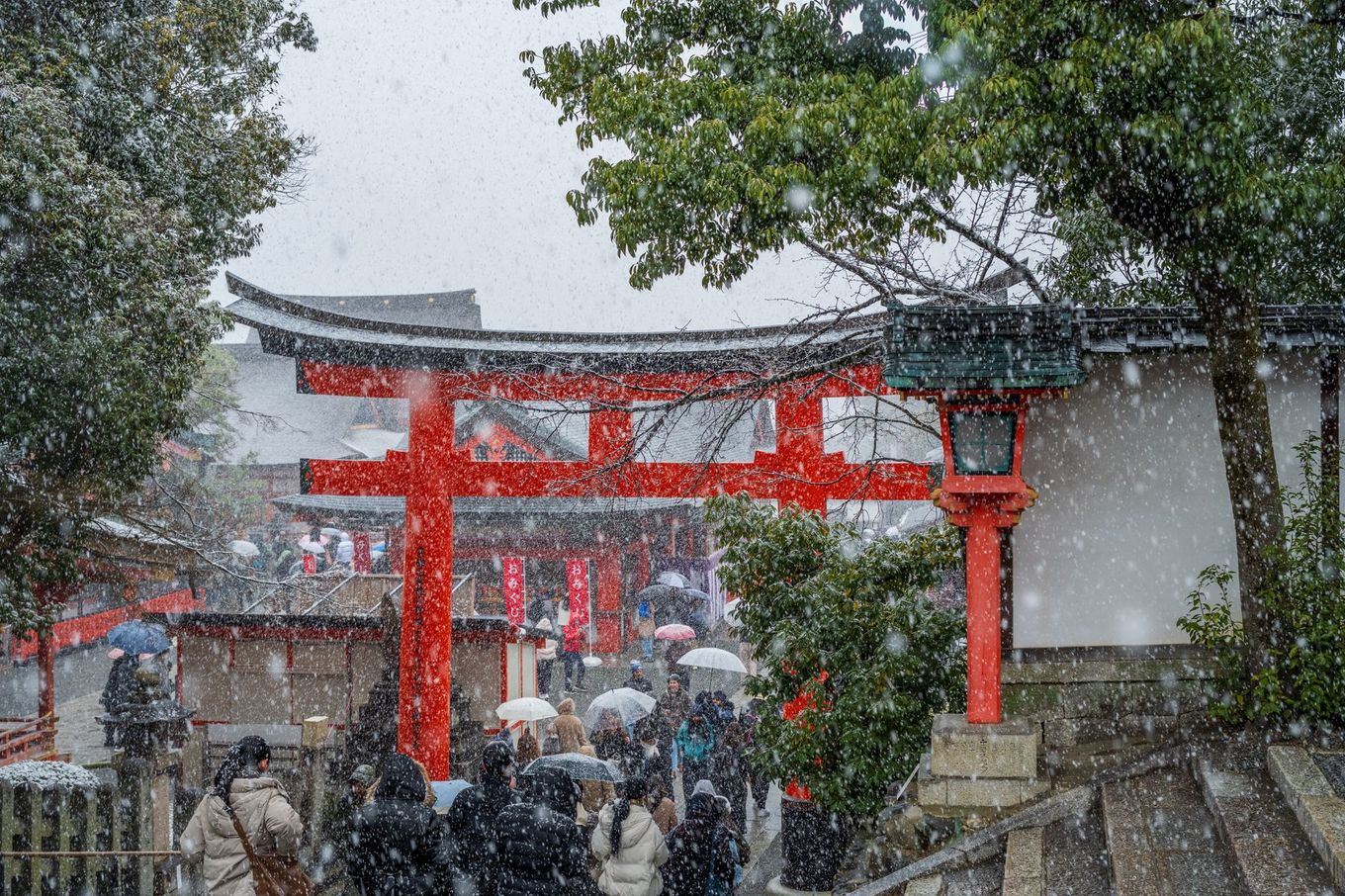
How often does it actually snow in Kyoto?
Often in the air, rarely on the ground. Kyoto's weather station records falling snow on 16.3 days in an average January and 14.2 in February. But snow at least 1 cm deep on the ground shows up on just 0.7 days in December, 1.3 in January and 2.0 in February: about four days a winter, per JMA's 1991-2020 normals. Total snowfall averages 2 cm in December, 5 cm in January and 7 cm in February.
Recent winters match the averages. In winter 2024-25 the Kyoto station logged snow on the ground on four days: 10 January and 7, 8 and 24 February. In winter 2025-26 it was two days, 8 and 9 February, with a peak of 7 cm. Neither December had any. Most 'snow days' in the statistics are flurries that never settle.
It melts by lunchtime
Kyoto snow rarely survives the midday sun. JMA's hourly readings tell the story. On 8 February 2025 the station measured 8 cm at 10:00, 3 cm at noon and nothing at 14:00. On 9 February 2026, 4 cm at 09:00 was gone by noon. The snowy Golden Pavilion you have seen on Instagram is a morning shot, taken on one of a handful of mornings a season.
How to catch it anyway
Keep two or three mornings of your trip loose, check the forecast the evening before, and be at the gate at opening time. Kinkaku-ji opens at 9:00 every day of the year (¥500 for adults). Kiyomizu-dera opens at 6:00. The official station sits in central Kyoto; Kinkaku-ji lies at the foot of the northern hills and can hold snow a little longer, but plan in hours, not days.
If snow is the reason for the trip, Kyoto is the wrong city to bet on. Shirakawa-go is a far safer winter picture: our Shirakawa-go in winter guide covers the buses and the light-up evenings.
How cold are the temples, and what should you wear?
As cold as the street, so dress for 1-10°C and assume no heating. Most temple halls are wooden and unheated, and you take your shoes off on the floorboards. Kyoto City's own notice for a winter-campaign talk at Kodai-ji in January 2026 told guests to remove their shoes and bring slippers if they wanted them. Wear thick wool socks, layers you can open indoors, and shoes that slip on and off in seconds.
Expect frost. Kyoto averages 7.4 nights below 0°C in January and 6.7 in February, and only 2.2 in December. Days are mild enough to walk all afternoon, but the cold sits in the stone paths and the tatami rooms, not the air. The kit that matters:
- Wool or thermal socks, two pairs a day if you visit several halls.
- Slip-on shoes. Laces at every temple door get old by the third stop.
- A thin base layer and a packable down jacket instead of one heavy coat.
- Stick-on heat packs (kairo) from any convenience store, one for the lower back.
The full list is in our Japan winter packing list. For the evening, a hotel with a large communal bath fixes cold feet better than anything you can pack: see our hotels with public baths guide. Kyoto City's notice on the shoes-off rule is in its November 2025 press release.
How much cheaper are Kyoto hotels in January and February?
About 40-45% cheaper than April. Kyoto's major hotels averaged ¥17,645 a room in January 2026 and ¥17,678 in February, against ¥31,296 in April 2026, the highest monthly figure since the survey began in 2014 (Kyoto City Tourism Association, per room, excluding tax). One chain hotel shows the same gap for 2027: ¥13,200 for a double on 20 January against ¥21,600 on 7 April. That is roughly $84 against $137.
The single-hotel check is Toyoko Inn Kyoto Shijo-Karasuma, a no-frills chain hotel downtown, priced on its official site on 30 October 2026 for two adults in a double, breakfast and consumption tax included. 20 January and 17 February 2027 were both ¥13,200; 9 December 2026 was ¥17,000; 1 and 7 April 2027 were ¥21,600. That is 39% less in deep winter than in early April, for the same room.
December is cheaper than spring but not cheap. The citywide average was ¥21,638 in December 2025, at 77.9% occupancy. The survey's averages cover every room type and exclude tax, so a central three-star double on a weekend will sit above them; read them as the direction of travel, not your quote. Dollar figures here use ¥158 to the dollar (30 October 2026).
Budget Kyoto's lodging tax on top. It is charged per person, per night: ¥200 below ¥6,000, ¥400 from ¥6,000, ¥1,000 from ¥20,000 (Kyoto City). At the winter average of about ¥17,700 a room, two people each fall in the ¥400 band. For which side of town to pick, see Kyoto Station vs downtown.
What is open only in winter in Kyoto?
The main event is Kyo no Fuyu no Tabi, the city's winter special opening of temple buildings that are normally closed. The 2026 edition, the 60th, ran from 9 January to 18 March 2026, with standard entry of ¥800 per site for adults. The 2027 programme had not been announced when we checked on 30 October 2026. Sites and dates change every year, so check before you fix your days.
Some 2026 sites were priced differently from the standard rate, several had their own closing days or shorter windows inside the main period, and a few guided visits needed a web reservation. Treat it as a reason to come between mid-January and mid-February, when the most sites overlap.
The other winter-only draw is plum blossom. At Kitano Tenmangu, the shrine says its early plums start opening after New Year and the plum garden usually opens in early February and runs to late March, with the Baikasai festival on 25 February. Entry in 2026 was ¥3,000 on the day, during an art installation; the 2027 price is not yet published.
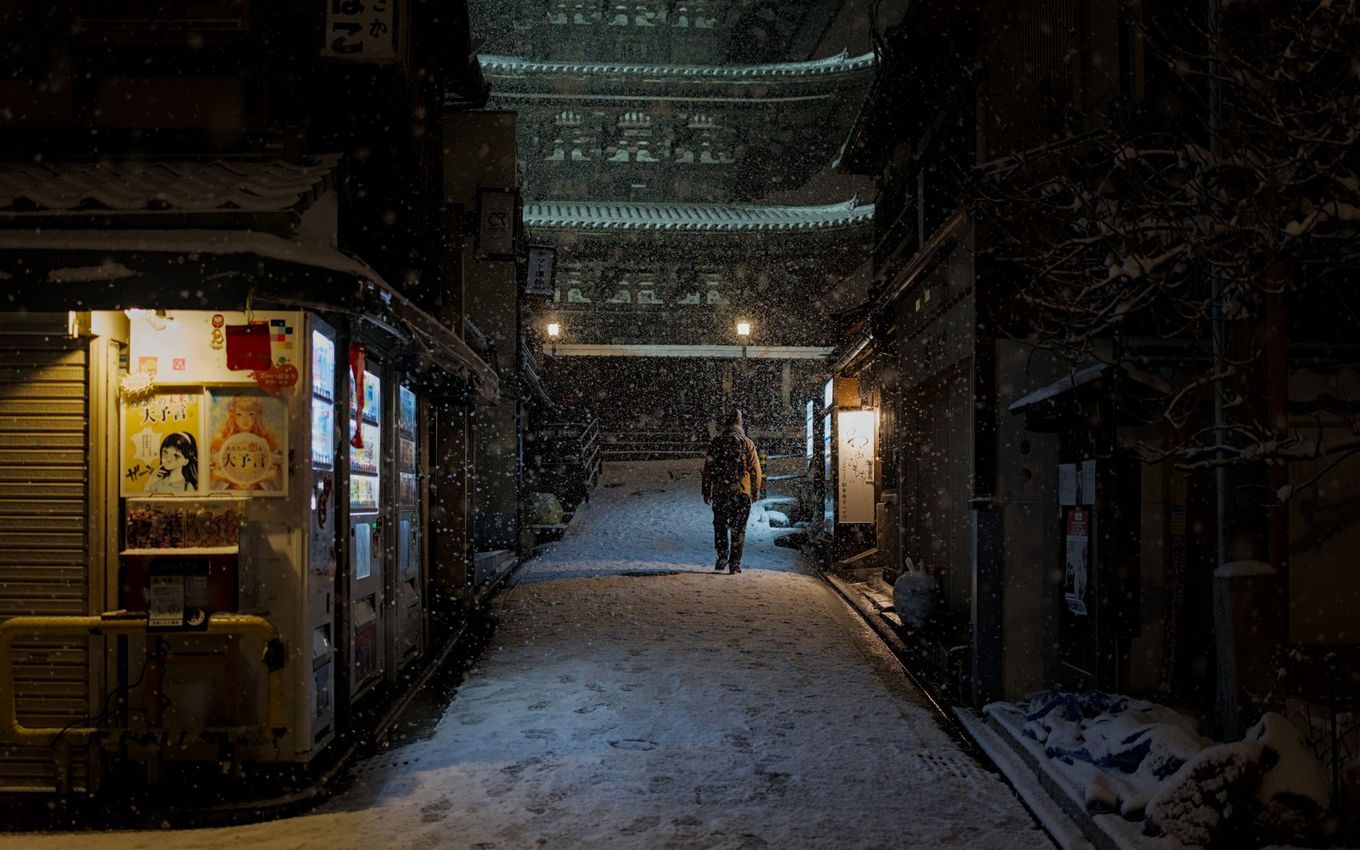
December, January or February in Kyoto: which month?
February, with January a close second. February has the best snow odds (2.0 days with snow on the ground), the first plum blossom and hotel rates level with January: ¥17,678 against ¥17,645 in 2026. January is just as cheap but starts with the New Year crush on 1-3 January. December is the mildest month (11.6°C by day) and the priciest of the three, at ¥21,638 a room.
Weather normals barely separate them: January and February sit within 1°C of each other. The real differences are price, snow and the calendar. Which month suits Japan as a whole, not just Kyoto, is in December, January or February?.
| December | January | February | |
|---|---|---|---|
| Day / night | 11.6°C / 3.5°C (53°F / 38°F) | 9.1°C / 1.5°C (48°F / 35°F) | 10.0°C / 1.6°C (50°F / 35°F) |
| Days with 1 cm+ snow on the ground | 0.7 | 1.3 | 2.0 |
| Total snowfall | 2 cm | 5 cm | 7 cm |
| Hotel average · occupancy | ¥21,638 · 77.9% | ¥17,645 · 65.7% | ¥17,678 · 73.7% |
| Watch out for | 29 Dec-3 Jan closures | 1-3 Jan hatsumode, 9-11 Jan long weekend | Lunar New Year Sat 6 Feb |
| Our pick | Yes, before 25 Dec | Yes, from 4 Jan (skip 9-11) | Best month |
Coming from Tokyo? The Nozomi is ¥14,170 for a reserved seat in the regular season (¥8,360 fare plus ¥5,810 express charge). On off-peak weekdays such as Wednesday 20 January 2027 the express charge drops by ¥200, to ¥13,970 in total. How to book it is in our Shinkansen booking guide.
Which days should you avoid in Kyoto this winter?
Avoid 29 December to 3 January unless hatsumode is the point, and the 9-11 January long weekend: Coming of Age Day is Monday 11 January 2027. If you hate crowds, also skip the Lunar New Year weekend, as Lunar New Year falls on Saturday 6 February 2027. National Foundation Day (Thursday 11 February) and the Emperor's Birthday (Tuesday 23 February) are single days, not long weekends. The rest of January and February is fair game.
New Year is its own trip. Big shrines such as Fushimi Inari are packed for hatsumode on 1-3 January, museums close, and the Nozomi runs reserved-only. We cover all of it, venue by venue, in Japan over Christmas and New Year, so we will not repeat it here. From 4 January the city reopens and empties out at the same time: that is the window. Our Japan in January guide has the rest of the month.
Holiday dates are from the Cabinet Office holiday list; the Lunar New Year date is from the Hong Kong Observatory calendar. Don't rebuild a trip around Lunar New Year.
Frequently asked questions
Will I see snow in Kyoto in January?
Probably flakes, probably not a white city. JMA's normals give 16.3 days of falling snow in January but only 1.3 days with 1 cm or more on the ground. In winter 2025-26 Kyoto's station had no snow cover at all in January; the only two days came on 8-9 February.
Is Kyoto in January worth it for a first trip, or should I wait for spring?
Go in winter if crowds and hotel prices bother you more than bare trees. January 2026 hotels averaged ¥17,645 a room against ¥31,296 in April. Wait for spring only if the blossom is the reason you are going.
What should I wear to Kyoto temples in winter?
Layers, thick socks and slip-on shoes. Days average 9-10°C and nights about 1.5°C, and you take your shoes off on unheated wooden floors. A thin down jacket and a base layer beat one heavy coat.
Is anything closed in Kyoto in winter?
Very little outside New Year. Temples and shrines stay open; Kinkaku-ji opens every day of the year, 9:00 to 17:00. The real closures are museums and small restaurants around 29 December to 3 January.
Will plum blossoms be out in mid-February?
Some, yes. Kitano Tenmangu says its early plums open after New Year and its plum garden usually opens in early February, running to late March. Full bloom depends on the year; the shrine's Baikasai festival is on 25 February.
Where is the nearest reliable snow from Kyoto?
Not in the city. For guaranteed snow, head to the Japan Sea side or the mountains; Shirakawa-go is the classic winter trip and works without a car. In Kyoto itself, treat a snowy morning as luck.
Next step: pick your base. Our guide to where to stay in Kyoto compares downtown, Kyoto Station and Gion, and winter rates put the nicer areas within reach.
