
Pick Nozawa Onsen. From Tokyo it is one Shinkansen to Iiyama, then a ¥600, 25-minute bus. After that the lifts, the beginner slopes and 13 donation-only public baths are all in one walkable village. Hakuba has more mountain: 10 ski areas on one ¥11,100 day pass. But they sit along a valley linked by buses, and a first-timer needs one gentle slope, not ten. Every fare here was read on official Japanese pages on 30 October 2026.
Hakuba or Nozawa Onsen: which is better for beginners?
Nozawa Onsen, if you are a first-timer without a car. The ski area and the village are the same place. You walk, or take the free village shuttle, to the Nagasaka gondola or the Hikage base, where the main ski school runs. Hakuba Valley is 10 separate ski areas sharing one pass. That is brilliant once you can ski. On day one it means choosing an area, then catching a bus there in rental boots.
The anti-hype point: "Hakuba" is not one resort. The Hakuba Valley pass covers Jiigatake, Kashimayari, Sanosaka, Goryu, Hakuba47, Happo-one, Iwatake, Tsugaike, Norikura and Cortina, spread across three municipalities. Each has its own base, its own lifts and its own school. The shared shuttle stitches them together.
Nozawa Onsen is one ski area run by one company, sitting directly above one village. Your lift ticket, your rental shop and your lesson desk are a few minutes apart. When you are tired at 14:00, you are already home.
Hakuba still wins for a mixed group where one person is a strong skier. They get ten areas; you get a bus to whichever base suits you. If nobody in your group has skied before, that variety costs you time every morning.
How do you get to each from Tokyo without a car?
Nozawa is quicker and cheaper. Take a Hakutaka Shinkansen from Tokyo to Iiyama: 1h38 to 1h57, ¥8,890 reserved in regular season. Then the Nozawa Onsen Liner bus: about 25 minutes, ¥600. For Hakuba, ride a Kagayaki to Nagano (77–90 minutes, ¥8,450 reserved), then the Alpico express bus to Hakuba Happo (about 70 minutes, ¥2,900). A direct bus from Shinjuku takes about 5h13 and costs ¥5,800–7,000.
Tokyo to Nozawa Onsen
Only the Hakutaka stops at Iiyama. On the timetable we checked for 20 November 2026 there were 11 direct Hakutaka a day from Tokyo, the first at 06:28 and the last at 20:12. The unreserved fare is ¥8,360. A reserved seat adds ¥530 in regular season, so ¥8,890. JR East prices reserved seats by season: ¥8,690 off-peak, ¥9,090 peak and ¥9,290 on the busiest days, such as 30 December.
The Nozawa Onsen Liner runs from JR Iiyama Station to the village for ¥600 (children ¥300). The timetable posted today runs to 30 November 2026, with 10 departures from Iiyama; the winter timetable is not out yet. The resort warns that some buses do not meet a Shinkansen, so check the times before you book your train. There is no public transport from the Iiyama Line stations Kamisakai or Togari-Nozawa Onsen to the village. The last Liner leaves Iiyama at 21:20, so the 20:12 Hakutaka from Tokyo (in 22:00) has no bus connection.
Tokyo to Hakuba
Every Hokuriku Shinkansen stops at Nagano. The Kagayaki is fastest at 77–90 minutes; a Hakutaka takes 93–98. The unreserved fare is ¥7,920; reserved is ¥8,450 in regular season, ¥8,250 off-peak, ¥8,650 at peak and ¥8,850 on the busiest days, such as 30 December.
From Nagano Station East Exit, the Alpico express bus reaches Hakuba Happo Bus Terminal in about 70 minutes for ¥2,900. That is the 2026 spring-to-autumn timetable, valid to 30 November, with 7 buses a day. Alpico has not yet posted the winter timetable or fares, so treat ¥2,900 as a guide.
The direct Alpico/Keio highway bus from Busta Shinjuku to Hakuba takes 5h13 by day. Fixed fares on the 2026 spring–autumn tariff are ¥5,800 Monday to Thursday, ¥6,100 on Fridays and days before holidays, ¥6,400 at weekends and ¥7,000 on peak days; web fares start at ¥5,200. It is cheaper than the train and slower by two hours. The airport buses from Narita and Haneda to Hakuba showed no service on Alpico's site on 30 October.
Skis, boots and a big suitcase on a bus transfer are a pain. Alpico's highway-bus pages warn that under-floor space is limited and skis may not fit. The usual Japanese fix is to send the bag ahead by courier: see our luggage forwarding guide and rent your gear in the resort.
How do you get around once you're there?
In Nozawa you walk. The village is compact, and a free village shuttle runs from 12 December 2026 to 28 March 2027, mostly for the climb to the lifts. In Hakuba you ride buses. The Hakuba Valley shuttle (Line V) costs ¥800 a ride without a pass and is free on any day you use a Hakuba Valley ticket. The Hakuba night bus is ¥500. Check the last departure before you sit down to dinner.
Hakuba's shuttle page is honest about the downside: on big snow days buses fill up, and a full bus will not take you. The last afternoon runs are the most crowded. With a beginner group carrying rental gear, that is the part of the day that goes wrong.
One trap with the Hakuba Valley pass: a day counts as used the first time you scan it on a lift or a shuttle. Ride the shuttle on a rest day and you burn a pass day.
Nozawa's shuttle also has a live location tracker, and the lifts close in stages from mid-afternoon. On a short winter day the walk back through the village is part of the fun, not a commute.
What do lift passes, rental and lessons cost in 2026-27?
Nozawa is cheaper. Its 2026-27 adult day ticket is ¥7,800 in regular season, ¥5,600 in the early season to 18 December and ¥6,100 from 29 March. Hakuba Valley's all-area day pass is ¥11,100; Happo-one alone is ¥9,800. At Nozawa's official rental shop a ski or snowboard set is ¥5,800 a day. A full-day English group lesson is ¥16,500, a morning lesson ¥13,000.
| Hakuba Valley (10 areas) | Nozawa Onsen | |
|---|---|---|
| 1 day, adult | ¥11,100 | ¥7,800 |
| 2 days, adult | ¥21,800 (valid 4 days) | ¥14,500 (consecutive) |
| 3 days, adult | ¥32,200 (valid 6 days) | ¥21,200 (consecutive) |
| 1 day, child | ¥6,400 | ¥4,700 |
| Small children | 5 and under free (under 3 at two areas) | Preschoolers free, one per paying adult |
For three ski days, the Hakuba Valley pass costs ¥11,000 more per adult than Nozawa. The Hakuba price buys flexibility you will not use in your first week. If you stay in Hakuba as a beginner, a single-area ticket such as Happo-one at ¥9,800 is the closer comparison.
Rental and lessons are where Nozawa's single operator helps. The official rental shop opens on 28 November 2026 and charges ¥5,800 a day for a ski or board set, or ¥9,500 with jacket, pants and helmet. Three days of a ski set is ¥15,400. English group lessons run from 21 December to 21 March, need at least two people and can fill up; bookings open on 1 September.
Hakuba has dozens of independent rental shops and schools. We found no single official rate card to quote, so we give no Hakuba number here.
Our estimate for a first-timer's 3 days in Nozawa: ¥21,200 lifts + ¥15,400 rental + ¥16,500 for one full-day lesson = ¥53,100 per adult, before food and beds.
What is there to do for non-skiers?
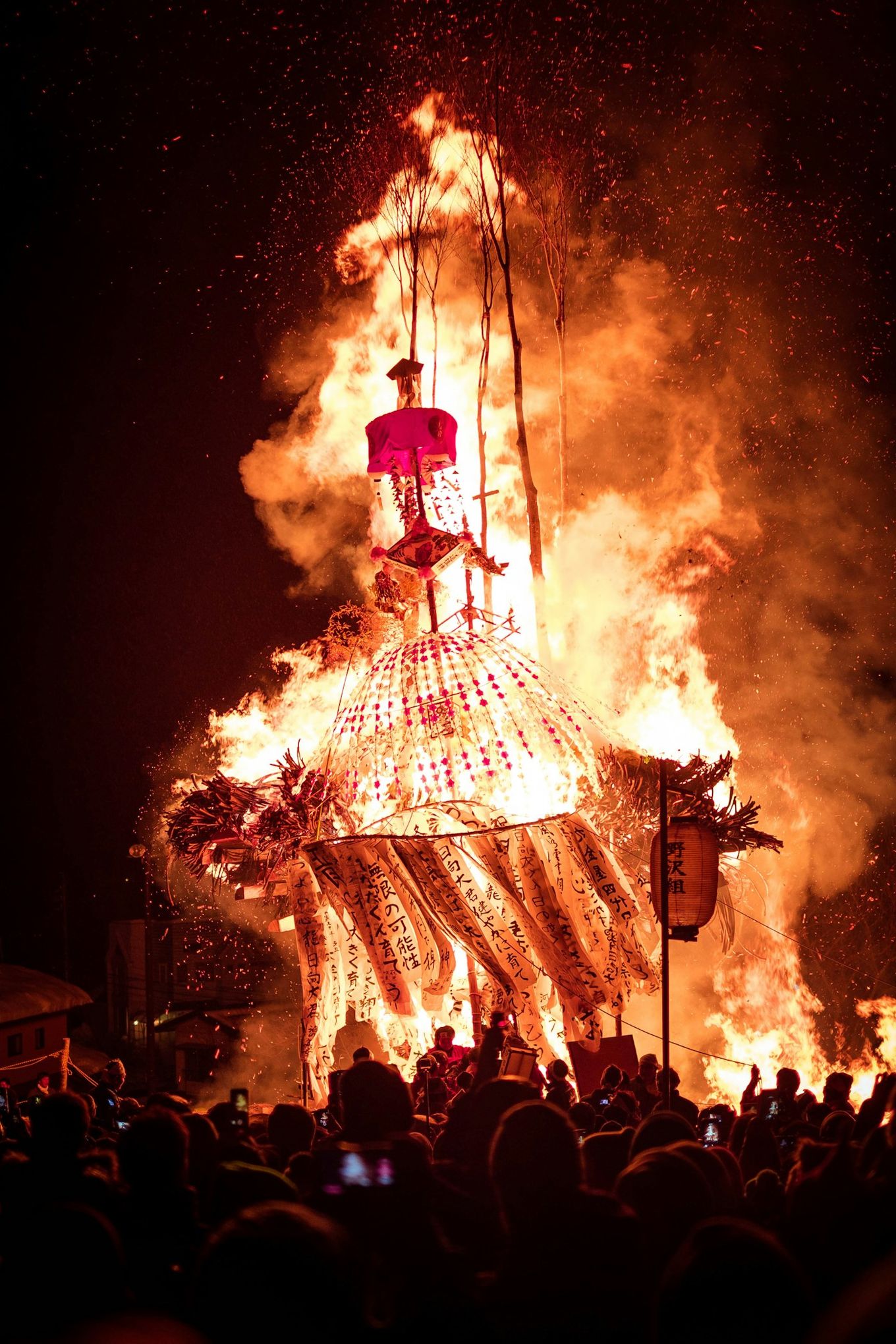
Nozawa wins again. Its 13 public baths, the soto-yu, are scattered through the village, kept up by local residents and open to anyone for a small donation. The landmark Ōyu bath is open 6:00 to 23:00 in winter. A non-skier can ride the Nagasaka gondola for ¥3,750 return. Every 15 January the village holds the Dōsojin fire festival. Hakuba's evenings are spread across several villages, so plan them around the night bus.
Bath etiquette is simple: wash before you get in, keep your towel out of the water, and leave a coin in the box. Each bath is maintained by a group of villagers, so it is their bathroom you are borrowing.
The snow monkeys at Jigokudani are a day trip from either base, via Nagano. Our snow monkeys guide has the buses and the times.
The Dōsojin festival on 15 January 2027 falls on a Friday. It is spectacular and very busy. If you are a beginner who wants quiet slopes, ski the days around it and watch the fire at night.
When is the snow best, and when are the crowds worst?
Go in January or February. JMA normals put average January snowfall at 366 cm in Nozawa village and 216 cm in Hakuba. Snow depth peaks in February at 199 cm and 97 cm. December is thinner: 88 cm and 46 cm at its deepest. Crowds peak over New Year, the 11 January, 11 February and 23 February holidays, and Lunar New Year in early February. Midweek in mid-January is the sweet spot.
Alpico's own fare table is a good crowd signal. Its peak-fare days for the 2026 season are 25 December to 3 January, 11 to 14 February and 20 to 23 February.
Early December is a gamble everywhere on Honshu. Nozawa prices that risk in: the early-season day ticket is ¥5,600 until 18 December. For a first-timer, enough snow on the beginner runs matters more than powder. If you want the full picture by month, read our guide to which winter month to visit Japan.
Spring skiing is cheaper and warmer. Nozawa's spring day ticket from 29 March 2027 is ¥6,100, and the season runs to 5 May. The snow is softer and slower, which many beginners actually prefer.
| Hakuba | Nozawa Onsen | |
|---|---|---|
| Tokyo to the slopes | About 3 h · ¥11,350 (via Nagano + bus) | About 2.5 h · ¥9,490 (via Iiyama + bus) |
| Direct bus from Tokyo | Shinjuku, 5h13, ¥5,800–7,000 | None on the official access page |
| Ski areas | 10 on one pass | 1, above the village |
| Getting to the lifts | Shuttle bus, ¥800 or free with pass | Walk or free village shuttle |
| Adult 1-day lift, 2026-27 | ¥11,100 (all areas) · ¥9,800 (Happo-one) | ¥7,800 |
| Avg January snowfall, village | 216 cm | 366 cm |
| Non-ski evenings | Spread out, night bus ¥500 | 13 public baths on foot |
| Winner for a first-timer without a car | Pick if someone already skis well | Nozawa Onsen |
Frequently asked questions
Is early or mid-December OK for complete beginners?
It can be, but it is a gamble. JMA normals give a December snow depth of 88 cm in Nozawa village and 46 cm in Hakuba, against 199 cm and 97 cm in February. Nozawa sells early-season day tickets at ¥5,600 until 18 December. Book accommodation you can cancel.
Can I do Hakuba and Nozawa Onsen in one trip?
Yes, via Nagano. Take the Alpico bus Hakuba–Nagano (about 70 minutes, ¥2,900 on the current tariff), the Shinkansen Nagano–Iiyama (11 minutes, ¥1,410 unreserved) and the Nozawa Onsen Liner (¥600). That is ¥4,910 and roughly half a day with connections.
Is there a direct bus from Narita or Haneda?
Not right now. Alpico's Narita–Hakuba and Haneda–Hakuba pages showed no service on 30 October 2026, and Nozawa's official access page points rail travellers to Iiyama and the Liner bus. Plan on the train via Tokyo.
Do I need to book ski lessons in advance?
Yes, in peak season. Nozawa's English group lessons run 21 December to 21 March, need at least two people to run and can be full; bookings open on 1 September. A full day is ¥16,500 for adults.
Do small children ski free?
Mostly. In Nozawa, preschool children ski free with a paying adult, one child per adult. On the Hakuba Valley pass, children aged 5 and under are free, except at Jiigatake and Kashimayari where it is under 3.
I can already ski. Is Hakuba better then?
Often, yes. Ten ski areas on one ¥11,100 pass, with the shuttle included, gives a confident skier a week of variety. Nozawa is one mountain with a walkable village.
Next step: check your dates against our guide to the best winter month in Japan, then pack with our winter packing list for Japan before you book the Shinkansen.
