
Yes, you can still see Ginzan Onsen as a day-tripper in winter 2026-27, but only on a timed, paid shuttle. From 19 December 2026 to 7 March 2027, day visitors leave cars and tour buses at Taisho Roman-kan and ride in. A round trip costs ¥700-1,500. The last bus out leaves at 19:30. For the lantern street without a clock running, stay one night in one of the town's 13 ryokan.
Can you still visit Ginzan Onsen as a day-tripper in winter 2026-27?
Yes, every day of the season, but not freely. From 19 December 2026 to 7 March 2027, every day visitor enters on a timed shuttle from Taisho Roman-kan, a rest stop about 2 km below the town. Shuttles go in from 9:00 to 18:00 and the last one back leaves at 19:30. Seats per slot are limited, and same-day tickets are sold only if seats remain. Book ahead.
The reason is safety, not crowd control for its own sake. There is only one road into Ginzan, and it is narrow. One car stuck in snow can block ambulances. Inside the town, roof snow falls on the building side of the street, so everyone walks on the river side of the centre line. That halves the usable street, so the town caps how many people are inside at once.
What changed from last winter: in 2025-26 most visitors already switched to a shuttle at Taisho Roman-kan, but a few official options drove straight in, including a ¥5,500 round-trip bus tour from Oishida Station with departures at 15:30 and 16:50. For 2026-27 the shuttle covers every hour of the day, with prices by time slot. Even route-bus riders without an entry booking are expected to get off at Taisho Roman-kan. As of 30 October 2026, no 2026-27 version of the Oishida bus tour has been published.
What are the 2026-27 winter entry rules?
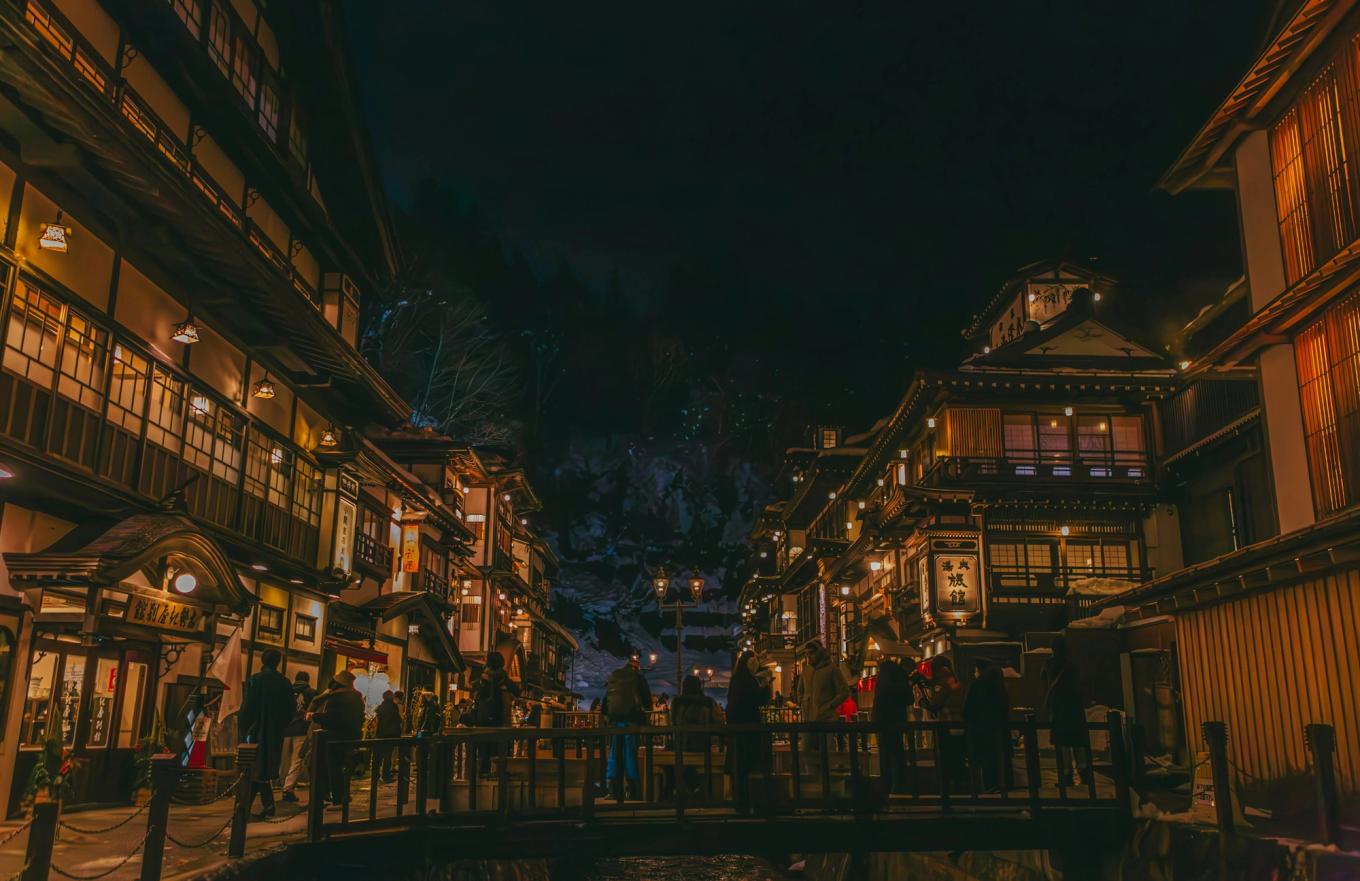
Three rules matter. No private cars or tour vehicles drive into town: you park at Taisho Roman-kan and switch to the shuttle. You choose an outbound time, and the price depends on the slot: ¥700-1,200 booked ahead, ¥300 more on the day. You get priority boarding back 90 minutes after your outbound time. And do not walk the 2 km road in: the town asks you not to.
Shuttle prices by outbound time (round trip, per adult)
- 9:00-11:00 departures: ¥1,000 booked ahead, ¥1,300 on the day.
- 11:00-14:00 departures: ¥700 booked ahead, ¥1,000 on the day. Cheapest, daylight only.
- 14:00-18:00 departures: ¥1,200 booked ahead, ¥1,500 on the day. This is the dusk and lantern slot.
Buses leave Taisho Roman-kan at :00, :20 and :40 past each hour and leave Ginzan at :10, :30 and :50. Advance tickets are card-only, with a ¥165 system fee per booking. Children of primary-school age and younger ride free, up to one per adult. Bath entry is not included. Your priority return time, 90 minutes after your outbound departure, is printed on the ticket. You can take an earlier bus if seats are free; if you miss your return slot, you lose priority and queue.
When tickets go on sale (Japan time)
- 9:00-14:00 slots, all dates: 1 November 2026, 9:00.
- 14:00-18:00 slots, 19-31 December: 1 November 2026, 9:00.
- 14:00-18:00 slots, January: 1 December 2026, 0:00.
- 14:00-18:00 slots, 1 February-7 March: 1 January 2027, 0:00.
1 November at 9:00 in Japan is 8 pm on 31 October in New York. Advance sales close at 17:00 Japan time the day before you ride. Advance seats per time slot are limited. On the day, the machine at Taisho Roman-kan sells timed tickets only if seats are left. The town warns that evening waits have reached 3 hours in the past. Arrive on time for your slot.
How do you get to Ginzan Onsen from Tokyo without a car?
Take the Yamagata Shinkansen Tsubasa from Tokyo to Oishida: about 3 hours 15 minutes and ¥12,780 one way in normal season. Every Tsubasa seat is reserved, so the price is the ¥6,930 base fare plus a ¥5,850 reserved express charge, which already includes the ¥530 seat fee. From Oishida, the local Hanagasa bus heads toward Ginzan. In winter, plan to switch to the shuttle at Taisho Roman-kan.
Tsubasa prices by JR East season (Tokyo to Oishida, one way)
- Off-peak, ¥12,580: Monday to Thursday from 1 to 27 December and from 7 January to the end of February, except holidays and the day before a holiday.
- Normal, ¥12,780: Fridays to Sundays in winter, and all of March until 20 March.
- Peak, ¥13,180: 28 December 2026 to 6 January 2027.
Sample direct trains on a January weekday: Tokyo 9:24 to Oishida 12:16, 10:00 to 13:16, 12:00 to 15:15. Back: Oishida 17:27 to Tokyo 20:48, and the last one at 20:12, arriving 23:28. A normal-season round trip is ¥25,560.
The Hanagasa bus from Oishida to Ginzan costs ¥1,000 on Obanazawa City's fare table and took about 36 minutes on the city's last posted timetable, which dates from 2021. Check current times at the Oishida bus stop. Planning more of northern Japan by train? See our Tohoku without a car itinerary.
Is staying overnight at Ginzan Onsen worth it?
Yes, if the lantern street is why you are going. Overnight guests follow their ryokan's own transport instructions instead of the day-visitor booking system. You get the gas lamps after the last day bus leaves at 19:30, and again at dawn on a near-empty street. The catch is supply: 13 ryokan with 161 rooms in total, and ten of them have 14 rooms or fewer.
Price check: Notoya Ryokan's standard plan starts at ¥26,400 per adult with dinner and breakfast, two sharing a room, tax included, on its official booking page. The plan is listed for stays through April 2027, so winter dates can be booked or requested now. Winter weekends cost more. Our estimate is ¥30,000-45,000 per adult per night with two meals on a February weekend, based on the starting prices on two official booking pages (Notoya from ¥26,400, Ginzanso from ¥23,980) plus typical ryokan weekend markups. We could not read per-date winter rates, so treat it as a budget line, not a quote.
Have tattoos? Ask the inn before you book; rules differ inn by inn. A room with a private bath avoids the question, the same fix we suggest in our Hakone tattoo-friendly onsen guide.
| Option | Lantern time | Cost per adult | Main risk |
|---|---|---|---|
| Day trip from Tokyo | Dusk only, inside a 90-minute return window | ¥25,560 rail (normal season) + ¥1,200 shuttle + local bus | Evening slots sell out; a missed bus means a 23:28 Tokyo arrival or worse |
| Afternoon visit from a Yamagata or Oishida hotel | Dusk only, inside a 90-minute return window | ¥1,200 shuttle + local train and bus + your hotel | Same slot limits, but no late train home to catch |
| One night in a Ginzan ryokan | Evening and early morning, no shuttle clock | From ¥26,400 with two meals + ¥25,560 rail | Rooms sell out early; only 161 in town |
When is the snow and lantern scene at its best?
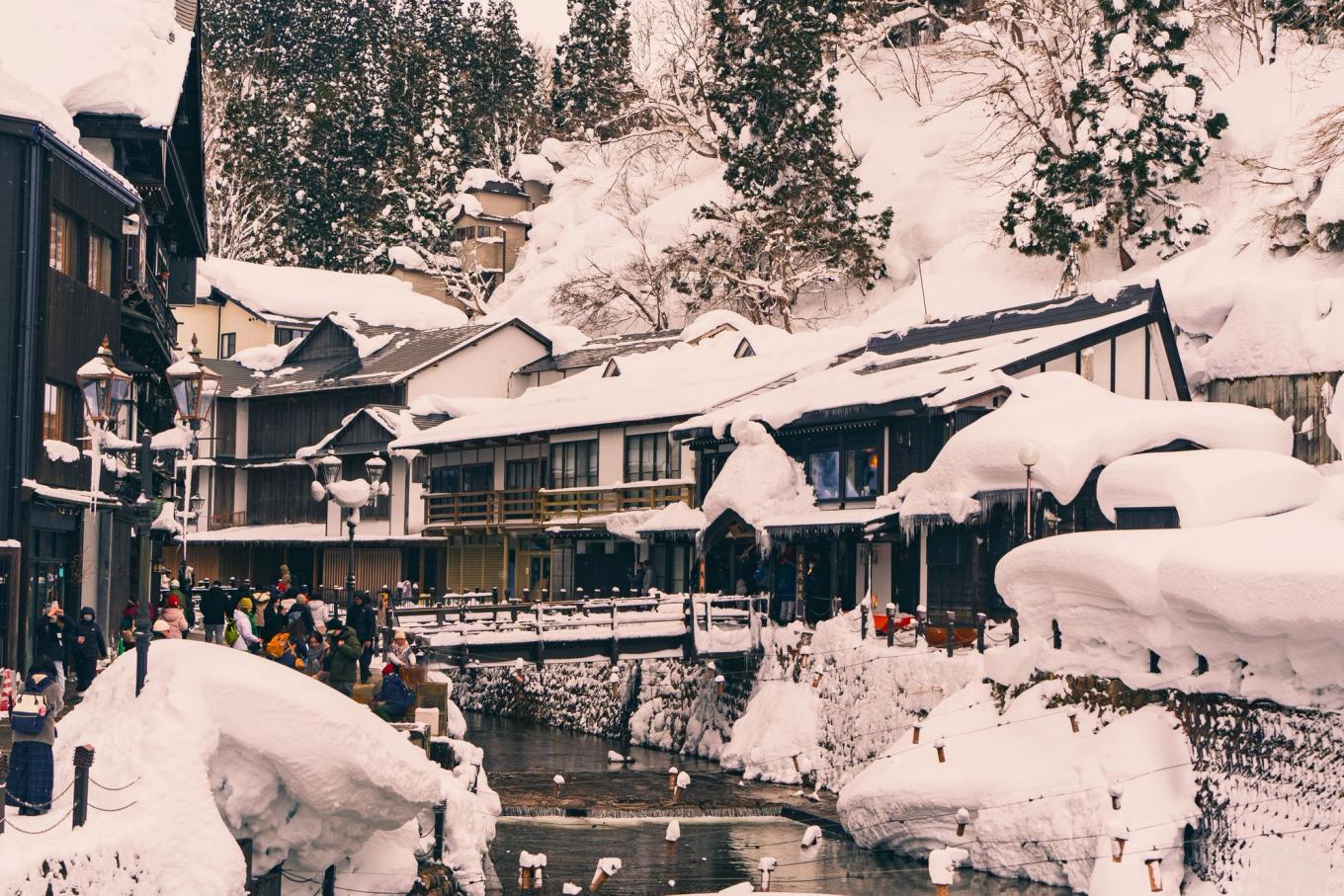
Late January through February. Obanazawa, the nearest weather station, averages a peak snow depth of 129 cm in January and 149 cm in February, against 76 cm in December. The light matters more than the date. The town says the valley goes dim about an hour before sunset, and sunset in Yamagata is 16:21 on 19 December, 16:42 on 15 January and 17:16 on 15 February.
For day-trippers that points to one slot. In mid-January, an outbound bus between about 15:00 and 15:40 gets you snow in the last daylight and the lamps coming on before your return seat. In February, shift it 30 minutes later. Dress for the cold: Obanazawa's January average is a high of 1.7°C and a low of -4.1°C. Ginzan itself has no weather station.
Still choosing a month for the whole trip? Our December, January or February guide weighs the rest of Japan against it.
What if you can't get a room in Ginzan Onsen?
Base yourself in Yamagata city or near Oishida and treat Ginzan as a timed afternoon visit. Book a 14:00-18:00 shuttle slot the day it goes on sale, aim for an outbound bus around 15:00, and you get daylight snow plus the lamps coming on. Oishida is the closest Shinkansen stop. Yamagata has far more hotels and is about 47 minutes from Oishida by local train.
Last winter the official site also listed a "Twilight Trip" day bus from Tendo Onsen with guaranteed entry, and a taxi plan from Akakura Onsen. Neither has a 2026-27 listing yet. Check the official access page in late November before you build a plan around them.
Frequently asked questions
Can you visit Ginzan Onsen in winter without staying overnight?
Yes. From 19 December 2026 to 7 March 2027, day visitors ride a timed shuttle from Taisho Roman-kan, going in between 9:00 and 18:00. The last bus out leaves at 19:30. Book ahead: it is ¥300 cheaper and same-day seats are not guaranteed.
How do I get from Yamagata city to Ginzan Onsen?
Take a train north to Oishida: about 47 minutes on the local Ou Line, or faster on a Tsubasa. From Oishida, ride the Hanagasa bus toward Ginzan (¥1,000 to the end of the line). In winter, day visitors switch to the timed shuttle at Taisho Roman-kan.
Can I walk from Taisho Roman-kan to Ginzan Onsen?
No. The town asks visitors not to walk the roughly 2 km road in winter. There is no usable sidewalk, so you would walk on a narrow, icy road with cars and poor visibility in snowstorms. Wait for the shuttle, even if there is a queue.
Do I need a shuttle ticket if I'm staying at a Ginzan ryokan?
The shuttle tickets are sold for day visitors. The official ticket page tells overnight guests to follow their inn's own transport guidance, so ask your ryokan how arrival works before you travel.
Zao Onsen or Ginzan Onsen in February, if I don't ski?
They are different trips. Ginzan is a short lantern-lit street you see in an hour or a night. Zao is a larger bathing and ski town where you can spend a full day. If the Ginzan photo is the goal, stay in Ginzan and add Zao on another day.
Is Ginzan Onsen worth it in December?
Less so for snow. Obanazawa's average peak snow depth is 76 cm in December against 149 cm in February. The winter shuttle rules start on 19 December 2026. Late January to February is the safer bet for the deep-snow scene.
Next step: you will stand at a shuttle stop in -4°C. Read our Japan winter packing list before you book.


